
How Advanced Mold Controllers Improve Injection Molding Profitability
Mold controllers may not be top of mind when looking for ways to increase performance and profitability. These devices regulate temperature, valve gate sequencing, and diagnostics across hot runner systems, and the latest generation has been evolving fast, driving significant gains compared to previous controllers.

Altanium® family of mold controllers.
Let’s take a closer look at some recent innovations in mold controllers and how they can impact your profitability:
What Are the Latest Innovations in Mold Controllers?
Recent innovations in mold controllers focus on three areas: advanced control algorithms, mold temperature control technology, and Industry 4.0 connectivity. Together, these advances give manufacturers greater precision, lower energy costs, and tighter integration across the production cell. Let’s explore all three in more detail:
Advanced control algorithms
Advancements in control software and algorithms are enhancing control of automated injection molding machines, enabling users to elevate mold controller performance, improve upon existing temperature control systems, and reduce energy usage.
At Husky, for example, we launched the latest generation of our proprietary Active Reasoning Technology (ART 2.0), an advanced intelligence platform providing the control foundation for the Altanium® family of mold controllers. The specific impact of ART 2.0 is covered in detail below.
Mold temperature control technology
Advancements in mold temperature control can prevent issues like mold overheating or undercooling, ensuring a consistently optimal molding process. These include:
- Dynamic mold temperature control: Also known as "variotherm" or "rapid heat-cool molding", this enables accurate temperature regulation during the injection molding process.
- Smart mold temperature control systems: These systems incorporate sensors to measure and monitor the temperature of the mold surface or cavity in real time, enabling immediate adjustments to heating or cooling parameters. The ART 2.0 control algorithm, for instance, has enhanced the temperature control capabilities of the Altanium® family of mold controllers.
Connectivity and integration
The integration of smart, connected machinery, networking, and data analytics is being leveraged to monitor and optimize the injection molding process, improving efficiency, productivity, and profitability. Husky's Altanium® family of mold controllers is Industry 4.0-ready, making it a highly integrated platform built for the demands of modern molding environments.
The importance of connectivity and integration will only increase with the rise of automation, including further adoption of:
- Automated robotic unloaders
- In-mold sensors
- Advanced hybrid molding machines
How Do Mold Controllers Impact Injection Molding Profitability?
Staying ahead with advanced mold controllers can play a pivotal role in the production process, significantly impacting your bottom line in several ways:
Quality control and defect prevention
Integrating quality control into the start of the production process reduces issues and failures. When temperature and process parameters are managed precisely from the first cycle, defects are addressed before they affect output.
energy efficiency
Advanced mold controllers reduce energy consumption during startup, enhancing overall energy efficiency. Optimized power delivery means less wasted heat and lower operating costs across every production run.
Reduced human error and variation
Standardized machine controls minimize the impact of human error and variation, resulting in more consistent and efficient production processes.
Increased productivity
Advanced mold controllers enable operators to produce more parts per startup and electrically qualify molds before production begins. Modern controllers also serve as advanced troubleshooting tools, minimizing unplanned downtime.
Reduced unscheduled downtime
Husky's Altanium® family can detect faults and take corrective action to keep producing parts, minimizing unplanned downtime. These controllers can also interlock with injection molding machines to prevent mold damage, enhancing process reliability.
Husky's Altanium® Family of Mold Controllers
Husky's Altanium® Mold Controllers provide a highly integrated, streamlined platform for managing hot runner temperature, mold servo, and valve gate sequencing, along with diagnostic and fault recovery features. They are available in various configurations for implementation in any injection molding environment.
All Altanium® controllers are Industry 4.0-ready and now incorporate ART 2.0 for enhanced hot runner temperature control through advanced autotuning and heat-up strategies.
Altanium® Mold Controllers also excel in diagnostics and fault recovery, supported by the versatile H-Series Intelligent Control Cards. These cards underpin Altanium's core capabilities:
- Temperature control and diagnostics
- Fault detection and recovery
- Interchangeability across the full Altanium® product line
- Multiple configurations to suit different temperature control needs and budgets
How Altanium® with ART 2.0 Improves Performance & Profitability
The ART 2.0 control algorithm enhances Husky's hot runner temperature control by incorporating more advanced autotuning and heat-up strategies. In controlled tests, Altanium® with ART 2.0 heated and stabilized the mold significantly faster than all three competitor mold controllers tested. This performance translates directly into profitability across four key areas.
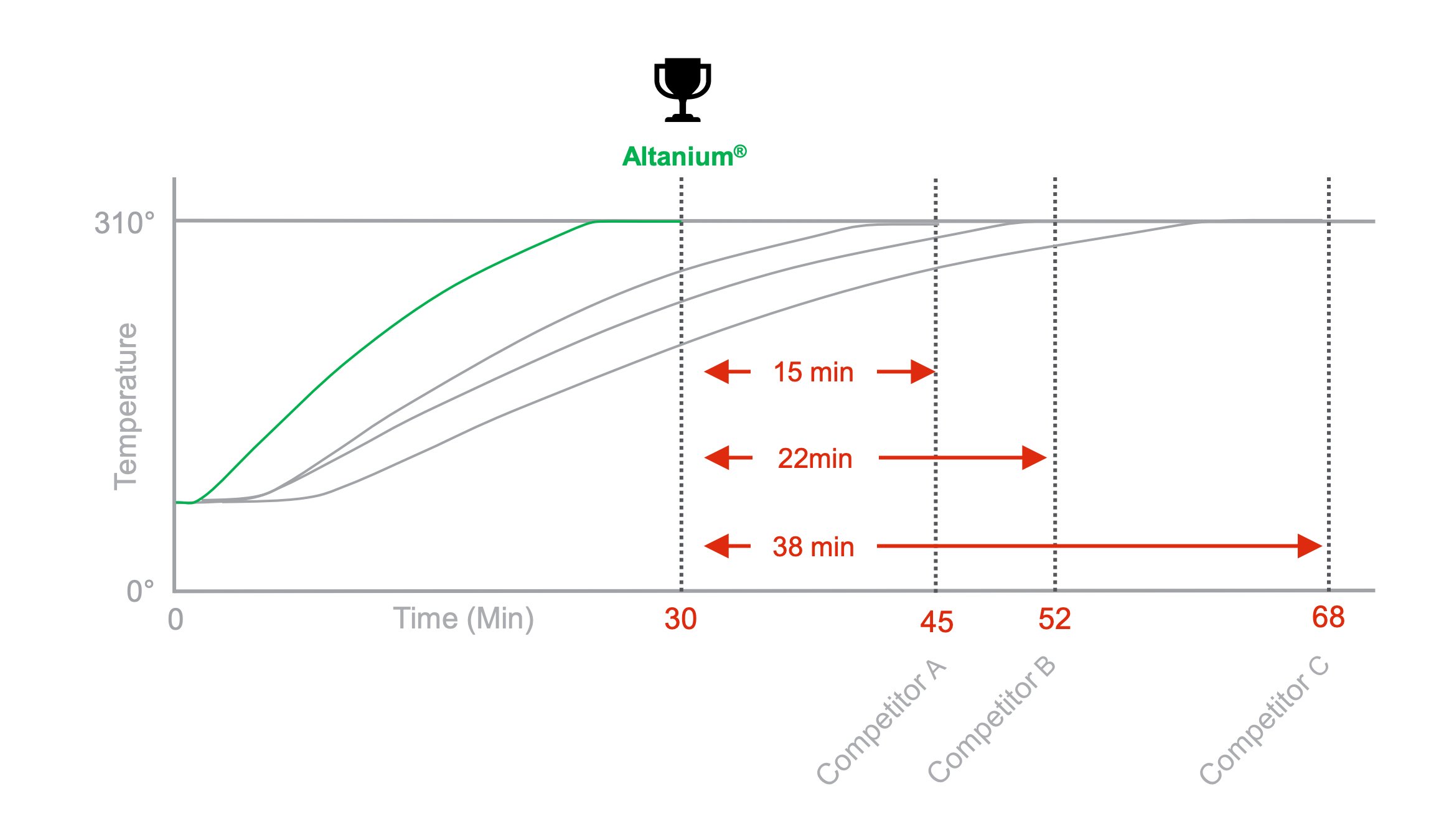
In controlled tests, Altanium® with ART 2.0 heated and stabilized the mold significantly faster than all three competitor mold controllers.
Reduced startup time
When combined with UniStart or AltaStart, the ART 2.0 auto-tuning routine combines multiple parameter tuning and heat-up strategies to apply full power to the slowest heating zone. The result is faster heat-up and stabilization, enabling more parts to be produced per startup.
Extended manifold heater lifespan
During startup, traditional controllers deliver power to heaters for extended on/off periods. This causes frequent thermal contraction and expansion, contributing to premature failure of the manifold heater. Altanium® with ART 2.0 delivers power in a smoother, more consistent way, never allowing power to go to zero during startup. This greatly reduces stress on the manifold heaters, resulting in longer heater life and reduced costs over the lifespan of your system.
Optimized power delivery during startup
ART 2.0 with UniStart and AltaStart automatically classifies heater zones and applies power sequentially. The group with slower heating zones is powered up first, while the faster heating group is energized precisely to reach the set point simultaneously, minimizing unnecessary heating and reducing energy consumption.
Minimized resin degradation and waste
ART 2.0 with UniStart and AltaStart protects resin inside the nozzles from unnecessary heating during startup. This reduces resin degradation and waste, increasing profitability by ensuring quality parts are produced at each cycle.
What Results Does Altanium® with ART 2.0 Deliver?
The performance benefits of Altanium® with ART 2.0 are measurable. Compared to previous-generation controllers, users have achieved:
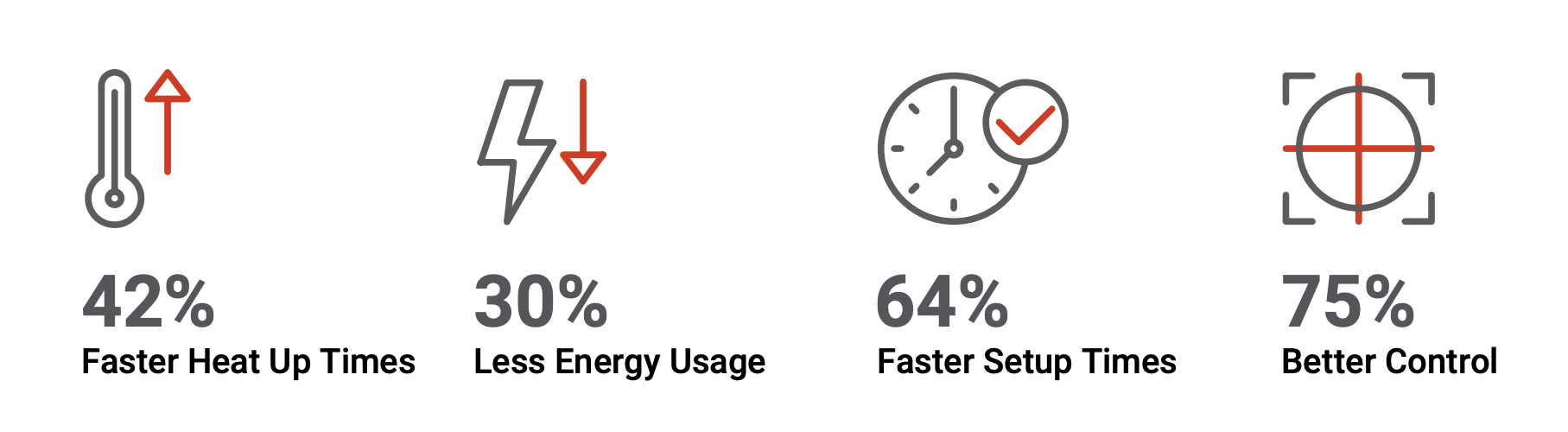
For more information on how Husky's Altanium® Mold Controllers can enable you to boost productivity and profitability, download the Husky Mold Controllers Guide.