
How to Reduce Color Change Time in Injection Molding
As brands market greater variety, require shorter production runs, and change designs more frequently, color change at processing has become an increasing focus for injection molders. To maximize productivity and reduce costs, processors need to examine their processes and equipment to optimize color change performance.
Hot runner systems play a major role in that optimization. In this article, we cover the key concepts that affect color change and how they influence hot runner design, the benefits of color change sequencing, new technologies that can reduce changeover time, and real-world case studies showing how targeted modifications to hot runner solutions can significantly improve color change performance.
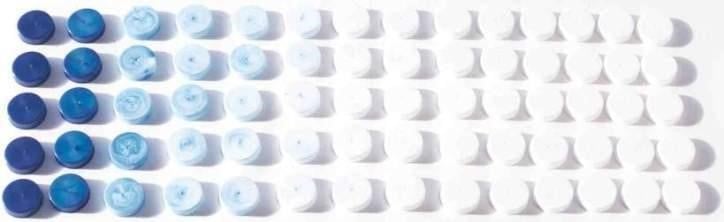
A process run’s collection of ejected parts, changing from blue to white.
Why Is Injection Molding Color Change Difficult?
For many large brand owners and OEMs, color is a key differentiator, central to consumer appeal and product identity. This is evident in beverage packaging, where a specific shade of red identifies Coca-Cola and a specific shade of blue identifies Pepsi. Consumer-focused companies are often extremely sensitive about color because it is tightly woven into their brand image.
Outside the industry, color change may seem straightforward: replace the old color with the new and keep making products. In practice, material must be cycled through the melt delivery system, replacing one color with another throughout the entire hot runner. Replacing color in a single shot is highly unlikely given the nature of the product and equipment involved.
Downtime and scrapped material are unavoidable when changing color to meet customer and brand requirements. A poor color change process results in excess wasted material, greater downtime, and increased scrap, all of which translate directly to higher production costs.
How Is Hot Runner Volume Measured for Color Change?
Hot runner volume is measured in two ways: melt volume, which tracks the total amount of material in the system, and shot count, which tracks how many shots it takes to move material from the sprue to the gate. Both measures directly affect how quickly color can be changed.
- Melt volume is measured in conventional units such as cubic centimeters or cubic inches. It represents the total volume of melt contained within the entire hot runner.
- Shot count is measured in shots and represents the number of shots needed to travel from the entry of the sprue to the gate entering the cavity. Shot count is directly dependent on the molding application, specifically part weight and mold cavitation, which together make up the shot size.
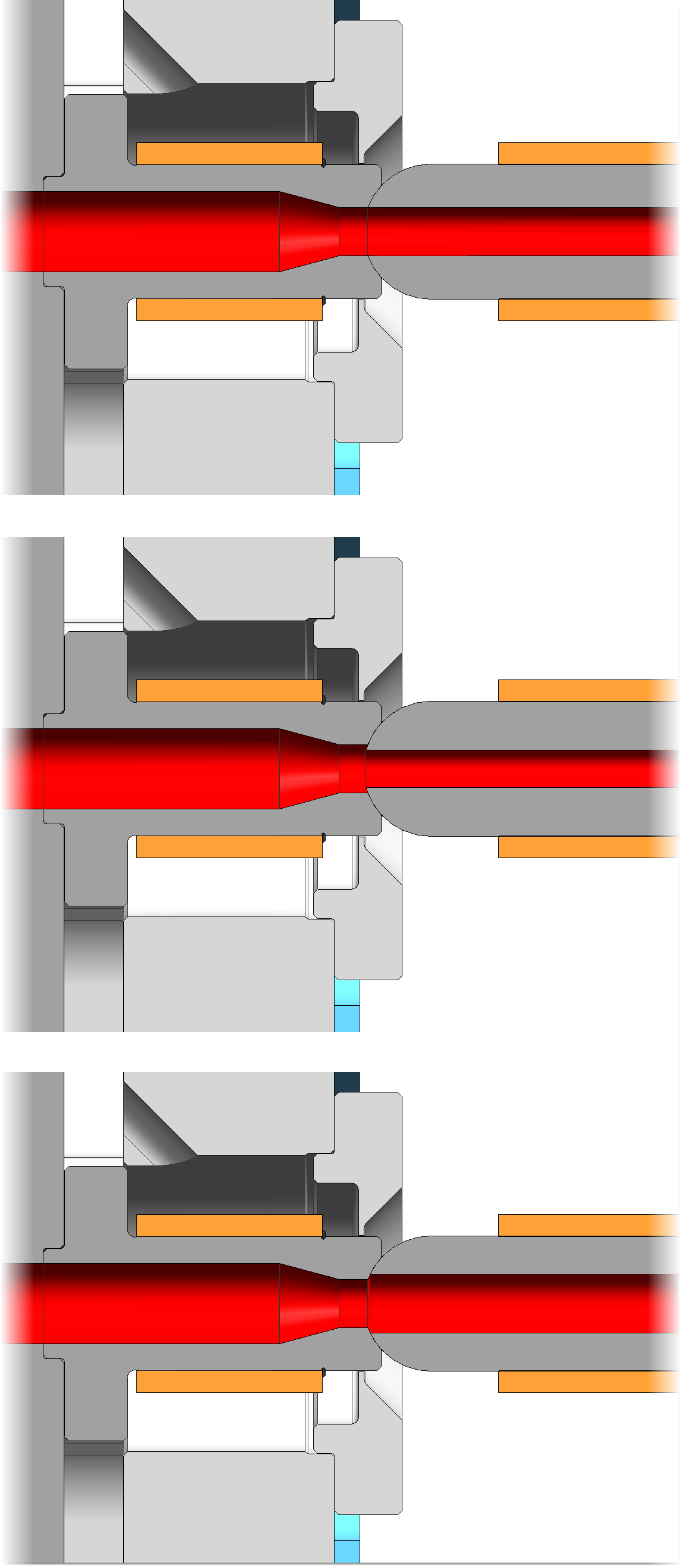
This graphic shows the machine nozzle interfaced with a hot runner’s sprue bushing. The top shows a matching melt channel interface, while the middle and bottom show mismatches and their potential melt stagnation areas.
Shot count is also related to a hot runner's melt volume. For example, if a hot runner is interchangeable between two molds, its melt volume stays the same for both applications, but the mold with heavier parts will decrease the hot runner's shot count. While shot count can be calculated in fractions of a shot, it can only be experienced in whole numbers. Neither measure is absolute, but both are useful for making comparisons and informed decisions.
What Are the Key Factors That Affect Color Change in Hot Runners?
Three factors have the greatest influence on color change performance in hot runner systems:
1. Residence Volume
Smaller volumes of molten plastic are easier to displace than larger ones. A smaller residence volume inside the hot runner means faster, more efficient color change. This volume is most directly managed by the hot runner's melt channel size, as there are typically few options when it comes to optimizing the melt path layout.
Minimizing melt channel size is straightforward in principle, but decreasing size typically increases pressure. During hot runner design, melt channel size must be carefully balanced against the resin, expected processing conditions, and known equipment limits.
2. Dead Spots in the Melt Path
Dead spots, areas of no flow, are locations where old color can snag, pool, or hide and resist displacement by the incoming melt stream. Old color trapped in these stagnant areas may unexpectedly bleed into the melt stream during production of the new color, generating reject parts. Material in stagnant areas may also degrade due to heat exposure and cause streaks.
These risks are not limited to the hot runner itself. The melt channel diameters at the hot runner sprue and machine barrel interface should also align and match as closely as possible.
3. Process Consistency and Procedure
Many variables affect color change and influence the ability to meet expectations. Process settings can help considerably, so it is important to know which settings can be adjusted. Designing a specific color change schedule and procedure directly manages the ability to meet those expectations. A clear plan is essential for any successful color change operation.
How Do Hot Runner Gates and Nozzles Influence Color Change?
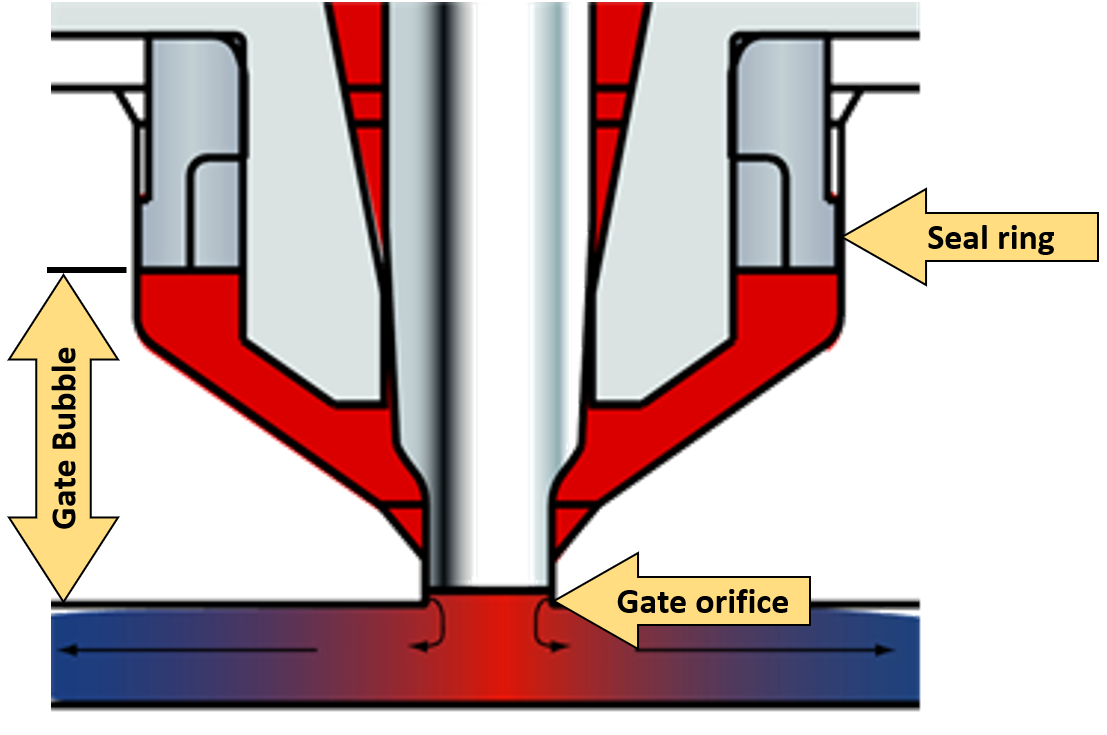
The gate bubble of most hot runner gates is the mass of molten plastic between the hot runner’s nozzle tip and the gate orifice.
Gates and nozzles affect color change primarily through the gate bubble, the mass of molten plastic surrounding the nozzle tip between the seal ring and the gate orifice. The size and design of this bubble determines how much old color is retained at the hot runner gate and how easily it can be displaced.
During processing, the resin contacting the gate material is cool and highly viscous, thermally insulating the melt that flows from the nozzle through the gate. This volume depends on the nozzle design and gate style.
Two approaches are used to manage gate bubble volume:
- Tip insulator: A high-temperature-resistant component that occupies the bubble volume, allowing melt to flush through more quickly.
- Cavity-sealing nozzle tip: Seals at the cavity interface, eliminating the gate bubble entirely so melt flows directly into the cavity with no tip insulator required.
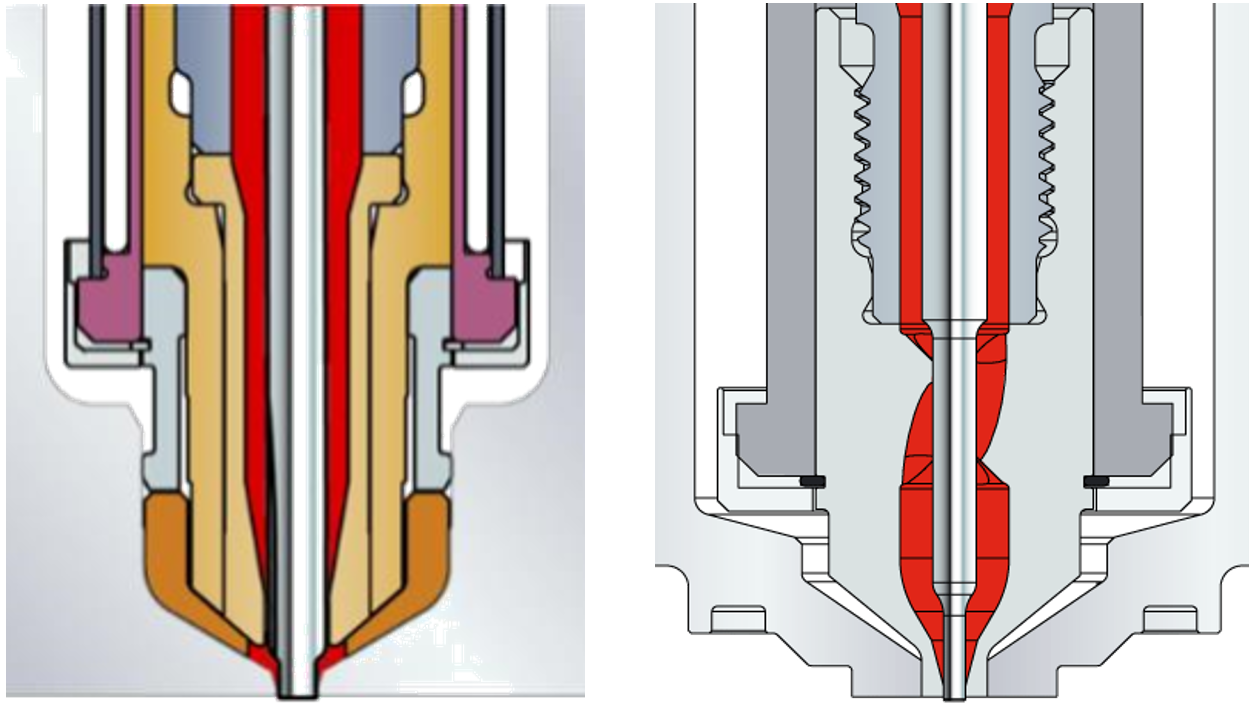
The nozzle at the left shows an assembly where the gate bubble is consumed by a tip insulator (brown). The nozzle at the right nullifies the gate bubble by participating as part of the cavity geometry.
How Does Hot Runner Manifold Design Influence Color Change?
Manifold design affects color change in any hot runner, regardless of nozzle or gating style. Some manifolds contain more melt than others, and that material must be replaced during every color change. Managing the amount of molten material through melt channel diameter is one of the most direct levers available.
Reducing melt channel diameter accelerates color change, but the design must also account for the pressure requirements of the application. Volume should be minimized, but not to the point where the pressure limit of the machine's injection unit is exceeded.
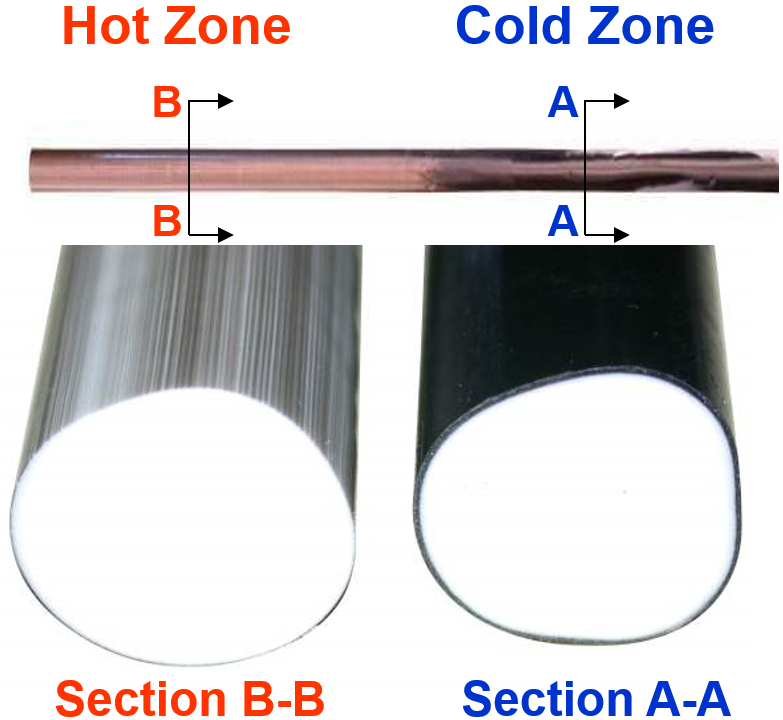
This graphic shows solidified plastic removed from a manifold melt channel after a few cycles of black-to-white color change. The hotter location (left) shows a thinner layer of old color than the colder location (right).
Thermal profile is another critical factor. A uniform thermal profile minimizes cold spots where the plastic boundary layer thickness at the melt channel wall can increase. That increased thickness at a cold location acts as a dead spot, creating the same color change difficulty described in the second core concept.
Based on field experience and thorough analysis, Husky has developed robust manifold heater guidelines applied to all custom hot runner systems. Thermal variation is minimized along the entire melt path by adjusting:
- Heater wraps and number of heater zones
- Thermocouple placement
- Melt channel layout
- Heat sink position and manifold shape
This combination of variables is validated using finite element analysis (FEA) to ensure minimal thermal variation, and all Husky manifold designs are FEA-validated for thermal profile.
How Hot Runner Manufacturing Influences Color Change
While design covers application and component decisions, manufacturing focuses on how the product moves from concept to the press. Thermal uniformity is a key consideration, and one way to minimize variation is through automated heater installation. This ensures consistent performance from each zone and each manifold. Resistance checks, power testing at final assembly, and thermal imaging provide additional validation of manifold heaters.
Manufacturing also has a major impact on minimizing dead spots in the melt flow path. Husky examined the effectiveness of manifold manufacturing systems by measuring and comparing color change timing across sample parts with various build conditions and resins. Several manifolds were built with different levels of variation, color change procedures were run, and performance was compared. The results showed that the best color change outcomes were achieved by applying consistent design principles, optimal gating, and minimized manufacturing variation.
How Does Color Change Sequencing Reduce Scrap and Downtime?
Color change sequencing addresses a variable that hot runner design alone cannot control: the order in which colors are run. Planning that sequence deliberately can reduce scrap and downtime as significantly as any mechanical or design intervention.
Color change timing varies by color. Changing from dark to light is relatively fast; the reverse generally requires more material and more time. Developing a thorough understanding of the color transitions required for each application, including running trials to map needs across the full product matrix, is a valuable investment.
Running colors in a set sequence, typically moving gradually from dark to light and back to dark, leverages both schedule and equipment on the production floor. This element of color change performance is often overlooked despite its clear impact on resin usage and downtime.
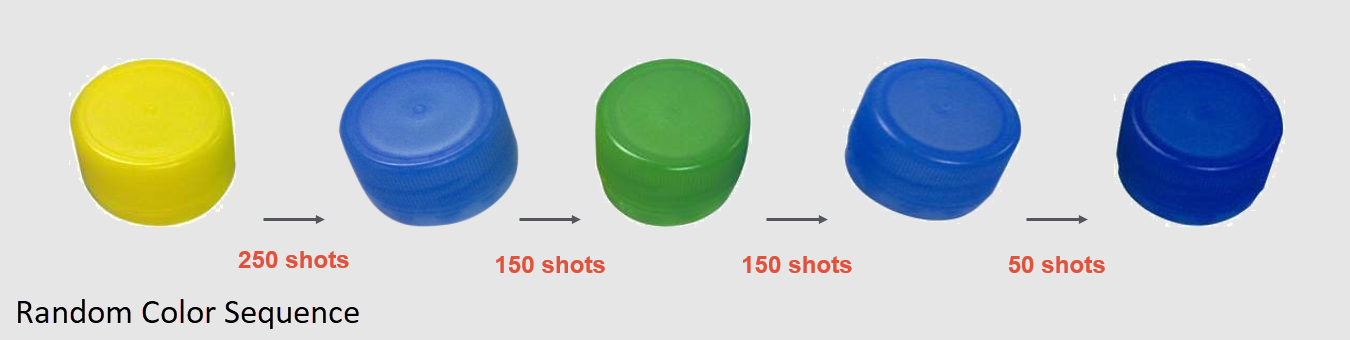
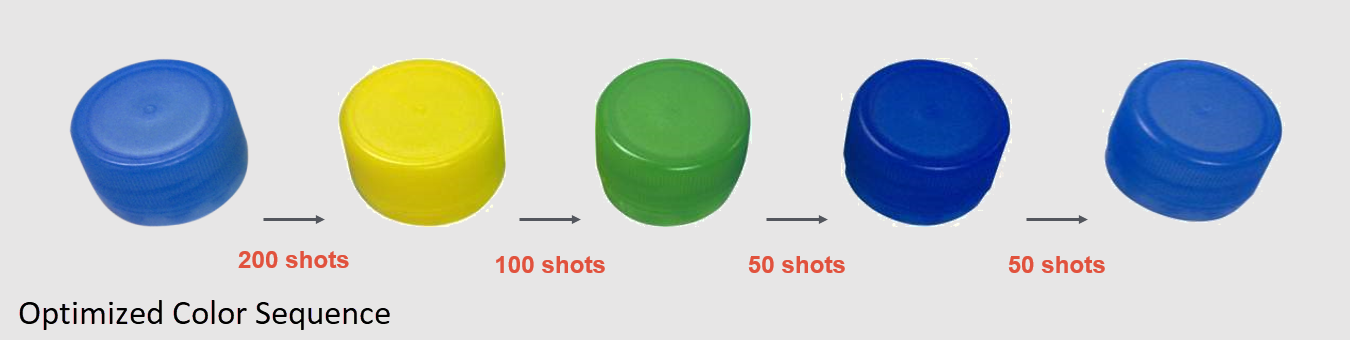
Many parts are molded with the same mold, hot runner, and material - but different colors. The top sequence above used a haphazard color plan. The bottom sequence used an optimized color plan, with a color change downtime reduction of 33%. Turnover between colors should be studied at validation to confirm when the best sequence to minimize operation costs.
How Does the Injection Molding Machine Affect Color Change Performance?
Hot runner design and production scheduling are two of the most impactful levers for color change performance, but additional technologies can further reduce color change time.
A system-based approach integrates the injection molding machine and hot runner temperature controller to deliver more consistent and efficient color changes when using purging compounds. Using the Husky Altanium® controller and its large touchscreen monitor, color change instructions can be integrated directly into the Altanium® software, providing precise guidance at the operator's fingertips.
Features such as soak timers, automatic temperature adjustments, cycle count input from the molding machine, and automated optimized procedures ensure that correct steps are followed every time. This delivers consistent, optimized results regardless of the machine or the experience level of the operator.
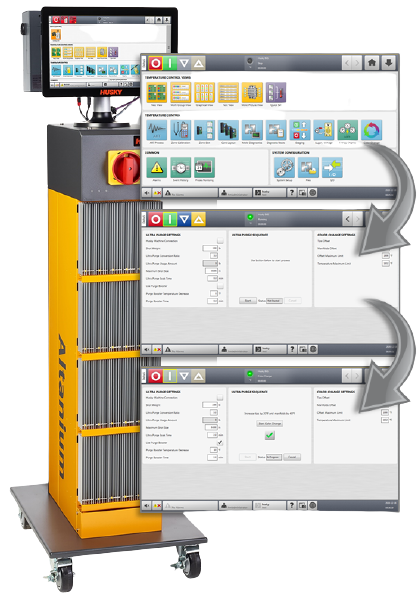
Altanium temperature controller features can be utilized to streamline color change processes.
Case Studies: Hot Runner Optimization in Practice
32-Cavity Polypropylene Closure Mold
On a 32-cavity polypropylene closure mold, changing from amber to natural color originally required up to 9,000 cycles over 28 hours before a part of acceptable color was produced. After Husky implemented targeted adjustments and changes, color changeover was reduced to 215 cycles in 40 minutes. This saved over 22,000 pounds of scrapped material and more than 650 hours of machine time.
Two-Shot Eight-Cavity Mold: Black to White
In a second case study, a two-shot, eight-cavity mold undertook one of the most demanding color changes: black to white using two different grades of polypropylene. After modifications and changes were applied, color change time was reduced from 1,100 cycles to 240, saving over 5,000 pounds of material and 150 hours of machine time per year.
Molded Closure: Color Sequencing Optimization
In one production example, a molded closure not optimized for color change required 57.6 kg of material to complete a full color change cycle. By changing the run order of those same colors, color changeover was reduced from 600 to 400 shots, and resin usage was reduced by 33%. Where production scheduling flexibility exists, optimizing run order can have a substantial impact on both resin usage and downtime.
What Drives Color Change Performance in Injection Molding
Color change optimization delivers significant value in terms of productivity and profitability. As brand owners and OEMs continue to focus on consumer appeal and product differentiation, processors of injection-molded parts will seek the best strategies to improve color changeover times. Optimized hot runner systems are well-positioned to meet that need through improved designs, refined manufacturing methods, and new technologies that keep color change performance ahead of evolving production demands.