
APR Recognizes Recyclable CSD Barrier Packaging with Up to 5% MXD6
Mitsubishi Gas Chemical (MGC) and REPI, long-time partners of Husky, have achieved another important milestone in the development of recyclable barrier PET packaging for carbonated soft drinks (CSD): recognition from the Association of Plastic Recyclers (APR) for up to 5% MXD6 content while maintaining full compatibility with the clear PET recycling stream.
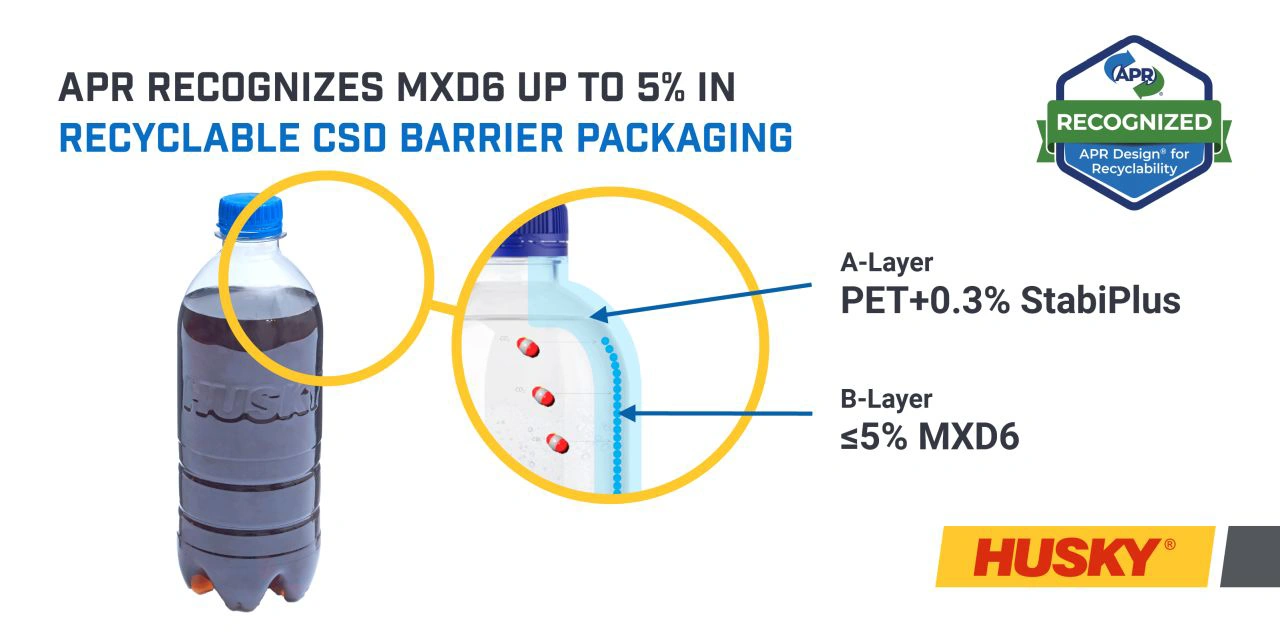
This recognition represents the latest step in the evolution of recyclable CO₂ barrier packaging, building on APR's original recognition of the technology at 2.5% MXD6 in 2020 and subsequent recognition at 3.3% MXD6. With the threshold now extended to up to 5% MXD6, beverage producers have access to the highest level of APR-recognized CO₂ barrier performance yet, expanding the range of bottle weights and package formats that can benefit from recyclable barrier PET technology.
APR recognition is globally referenced by brand owners, converters, and recyclers when evaluating compatibility with PET recycling streams. This latest milestone demonstrates continued progress toward packaging solutions that balance shelf-life performance, material efficiency, and recyclability.
Why is CO₂ Barrier Performance a Challenge for Small-Format CSD Bottles?
PET is the preferred packaging material for many carbonated beverages because of its clarity, durability, low weight, and favorable environmental profile. However, as bottle sizes decrease below 355ml, the surface-area-to-volume ratio increases significantly, accelerating CO₂ loss and reducing shelf life below acceptable levels.
The traditional response has been to increase bottle weight, using more PET resin to improve carbonation retention. While effective, this approach increases material consumption, transportation costs, and environmental impact.
Barrier materials such as MXD6 can significantly improve CO₂ retention, but conventional incorporation methods, including PET blends and low-precision multi-layer structures, may adversely affect PET recycling streams. As a result, many brands continue to view MXD6 as a potential recycling contaminant and rely on aluminum cans or glass for smaller package formats. While these materials provide excellent barrier performance, they also introduce trade-offs in cost, logistics, and environmental footprint.
A recyclable high-barrier PET solution addresses this long-standing challenge directly. Beyond enabling lightweighting and carbonation retention, higher barrier performance also extends the viability of PET bottles into more demanding distribution environments and climatic conditions where monolayer PET may not provide sufficient shelf life.
Expanding the Design Space for Small-Format CSD Packaging
As bottle weights continue to decrease, the percentage of barrier material becomes increasingly important, and APR recognition for up to 5% MXD6 expands the range of bottle formats that can leverage recyclable barrier technology while maintaining shelf-life performance.
The original APR-recognized solution at 2.5% MXD6 was ideally suited for bottles above 16 grams. Recognition at 3.3% MXD6 expanded applicability to bottles around 12 grams. Recognition for up to 5% MXD6 further extends the design space available to brands, enabling greater flexibility in balancing shelf life, lightweighting, recyclability, and cost.
For beverage producers, this means more opportunities to optimize package design without sacrificing performance.
How Co-Injection Technology Delivers Performance and Recyclability
Husky's high-precision co-injection technology allows packaging engineers to optimize both the amount and placement of barrier material within the bottle structure, placing MXD6 precisely where it is most effective and maximizing performance while minimizing material usage.
This engineering approach enables bottle designers to optimize multiple performance levers simultaneously, including PET weight, barrier-material usage, shelf life, and recyclability.
The result is engineered PET packaging that uses only the amount of MXD6 required to achieve the desired performance target.
Key benefits include:
- Enhanced CO₂ retention for lightweight small-format bottles
- Reduced PET usage through bottle lightweighting
- Optimized MXD6 consumption through precise placement
- Compatibility with established PET recycling streams
- Greater flexibility for demanding climates and distribution conditions
- Expanded design flexibility across a broader range of bottle formats
- Lower total material consumption while maintaining shelf-life requirements
By balancing barrier performance and recyclability, co-injection technology helps brands move beyond the traditional trade-off between product protection and circularity.
Helping Brands Meet Performance and Sustainability Objectives
For many beverage producers, the challenge is no longer simply extending shelf life. It is finding ways to improve performance and increase distribution reach while reducing material usage and supporting circular packaging goals.
The latest APR recognition demonstrates how recyclable barrier PET solutions continue to evolve, enabling brands to rethink packaging design for small-format carbonated beverages.
As sustainability expectations continue to increase, solutions that combine performance, recyclability, and lightweighting are expected to play an increasingly important role in the future of beverage packaging.
Learn more about Husky's advanced co-injection technology and how it can help optimize shelf life, lightweighting, and recyclability.