
The Real Cost of Spare Parts: Total Cost of Ownership
When budgets tighten, replacement parts are often one of the first places companies look to cut costs. It's easy to understand why: a lower-priced filter or hot runner component offers immediate relief on the maintenance bill, especially when every line item is under scrutiny.
But the full impact of that decision shows up on the production floor. When a replacement fails to perform as expected, unplanned downtime, excess scrap, or a missed shipment can easily erase the initial discount.
In this article, we'll examine the gap between purchase price and total cost, what that gap looks like in practice, and how leading producers build a parts strategy around long-term equipment performance.
The Cheapest Part May Not be the Lowest-Cost Decision
A replacement part may cost hundreds or thousands of dollars, but it supports a production system worth millions. Over a 15-year system lifecycle, a producer might, for example, invest $2.5 million in the initial equipment, another $1 million to $2 million in tooling refreshes, and roughly $800,000 in spare parts.
Spare parts represent a relatively small portion of the total investment, but they play an important role in keeping the equipment and tooling operating as intended.
That is why the price of an individual part does not tell you the full cost of choosing it. Saving a small amount up front has limited value if a component contributes to an equipment problem that costs far more in repairs, lost production, or scrap. The potential cost of the decision extends well beyond the part itself.
For producers running high-volume operations, the better question is what a replacement part costs in the context of the equipment and production it supports. That means considering its potential effect on uptime, throughput, yield, and overall equipment effectiveness alongside its purchase price.
The gap between price and true cost becomes clear the moment a lower-cost replacement fails to perform as expected.
Small Savings Can Create Very Expensive Downtime
Put simply: a lower-priced replacement part creates value only if it performs as reliably as the part it replaces. When a component falls short of exact equipment specifications, the immediate savings are quickly erased by secondary problems that ripple well beyond the maintenance department:
- Process instability
- Increased scrap
- Unplanned downtime
- Emergency service calls
- Missed production targets
A production line that sits idle still carries its operating costs while generating no output, so even a short interruption can cost far more than the original savings on the part.
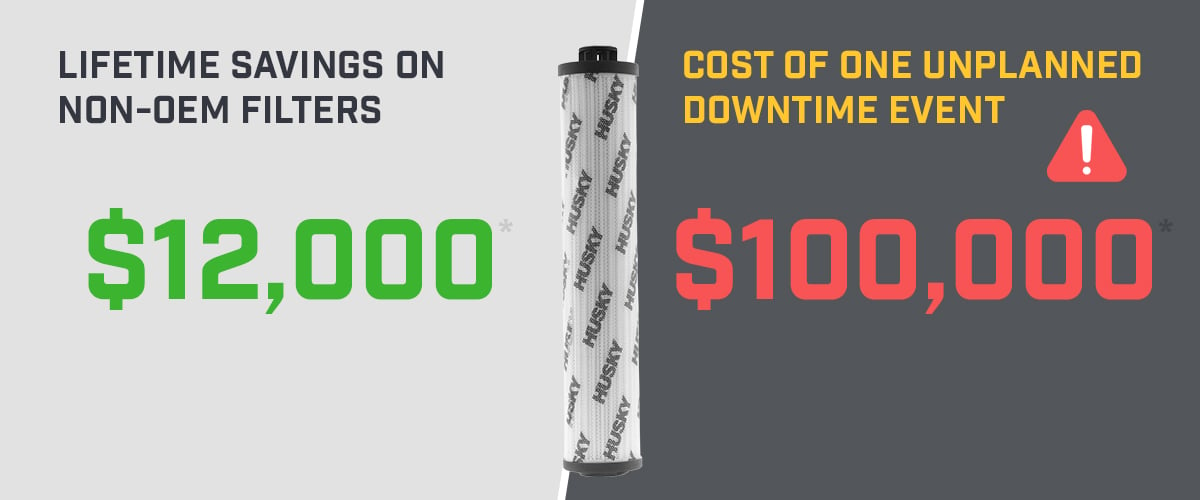
Over the life of a system, choosing non-OEM filters instead of genuine ones might save $12,000 in total. But a single downtime event caused by a failed filter can cost $100,000, more than eight times what was saved.
That doesn't mean every non-OEM filter leads to a failure of that size. It means the $12,000 in savings was never the full measure of the decision. In high-volume environments, reliability depends on components performing consistently across millions of cycles, not just on what they cost upfront.
Parts Built to Spec Keep Production Stable
A replacement part has to do more than function. It has to perform consistently within the exact system it was designed for. Genuine OEM parts are manufactured to the equipment's specifications, with the fit, dimensions, materials, and performance characteristics required for the application.
That consistency matters on a production floor. A component that fits differently or performs outside the expected range can introduce variation into a process that depends on thousands of components working together, showing up as:
- Changes in cycle time
- Inconsistent part quality
- Additional alarms
- More frequent adjustments from operators and maintenance teams
Hot runner preventive maintenance is a good example of what this looks like in practice. A single kit can include several small components, and small differences between genuine and non-OEM versions can affect how the whole system performs once it's back in production.
In one analysis of a Husky hot runner preventive maintenance kit, that variation carried a projected operational impact of $188,500, driven by lost uptime, quality issues, and added maintenance, not the price of the kit itself. The number shows how much can be riding on a component that looks like a minor maintenance expense.
Build a Parts Strategy That Reduces Long-Term Costs
Replacement part costs are easier to control when parts management is treated as an extension of the overall equipment strategy, not a reactive purchase made after something breaks.
A practical parts strategy starts with four priorities:
- Source from the manufacturer. Purchasing directly from the OEM helps ensure that replacement parts are genuine and manufactured to the equipment's exact specifications.
- Use available support and expertise. OEM parts specialists can help identify the right components, answer application questions, and determine what should be kept on hand for critical equipment.
- Plan maintenance around the equipment's requirements. Preventive maintenance schedules help identify replacement needs before components become a source of downtime.
- Plan for availability. Having access to the right parts when they are needed can reduce the time between identifying a problem and getting equipment back into production. For critical components, inventory planning can be especially important when a failure would stop a production line.
Husky supports this strategy through a global parts network, a dedicated team of parts specialists, and inventory built for fast turnaround when a critical component is needed.
The goal is straightforward: keep the equipment performing as intended, reduce avoidable downtime, and protect the production investment behind every part.