
How to Leverage Bioresins for Successful Injection Molding
Leading brands across the packaging, medical, and consumer goods industries are increasingly replacing traditional resins with bioresins in their injection molding operations. This shift helps producers future-proof production and stay ahead of tightening packaging legislation and shifting consumer preferences.
In this article, we'll break down what bioresins are, the challenges they present in injection molding, and how manufacturers can overcome them with the right equipment and preparation.
What Are Bioresins?
Bioresins are commercially viable materials derived from renewable biological resources. They're also called bio-plastics, bio-polymers, or bio-materials and include:
- Corn or maize starch
- Tapioca starch
- Potato starch
- Sugarcane starch
- Wood pulp cellulose
- Starches derived from vegetable oil
How Big Is the Bioresin Market?
The global bioplastics market was valued at over $11.5 billion in 2022, with a projected CAGR of 18.8% through 2030. Growth is regional too. The U.S. bioresin market is projected to grow at a 17% CAGR from 2020 to 2030. Europe is projected to grow at a 13% CAGR from 2022 to 2027.
This growth represents a significant opportunity for brands and producers willing to adapt their molding processes.

What Challenges Do Bioresins Present in Injection Molding?
Bioresins introduce three main challenges that manufacturers need to plan for before converting a line:
- Unique physical properties. Bioresins complicate standard molding processes because of:
- High viscosity
- Susceptibility to leakage
- The need for elevated pressure to fill mold cavities
- Temperature sensitivity. Many bioresins are highly sensitive to temperature, which creates problems for systems that weren't originally designed to handle them.
- Transitional performance and quality issues. Bioresins may not initially match the quality and performance standards of traditional materials. Molten bioresins tend to be corrosive. This can compromise processing equipment and require more frequent maintenance to keep production and product quality consistent.
How Can Manufacturers Overcome Bioresin Processing Challenges?
Husky clients working with bioresins have found success by following four strategic steps:
- Run a comprehensive pre-assessment. Before incorporating bioresins into the molding process, evaluate the material's suitability for the application:
- Check part design compatibility with the bioresin's rheology
- Determine whether resin testing is necessary
- Set maximum pressure guidelines
- Optimize manifold design. Manifolds need geometrically balanced channels and channel sizes optimized for low pressures and reduced shear rates.
- Upgrade hot runner systems. Hot runner systems need corrosion-resistant components, weepage mitigation elements, plunger valve gates, individual tip control, and improved heat distribution to control overshoot.
- Maintain consistent resin preparation. Dry bioresin thoroughly before use, keeping moisture content below 250 ppm to prevent hydrolysis and viscosity degradation. Store bioresin in foil-lined containers, dried to less than 400 ppm, and avoid exposing it to atmospheric conditions after drying.
How Does Husky's UltraMelt Hot Runner System Support Bioresin Processing?
Husky's UltraMelt™ technology is a premium melt-delivery system built for applications that require precise process and thermal control with minimal effect on resin chemistry.
UltraMelt™ was developed over six years and tested across more than fifty manifold designs. The system enables producers to manufacture small parts using materials that are especially sensitive to temperature and chemical reaction. Non-reactive surfaces and stainless steel components preserve the sensitive chemistry of bioresin materials while minimizing corrosion. Producers can choose from a range of gate methods, nozzle sizes, and actuation styles for both low- and high-cavitation molds.
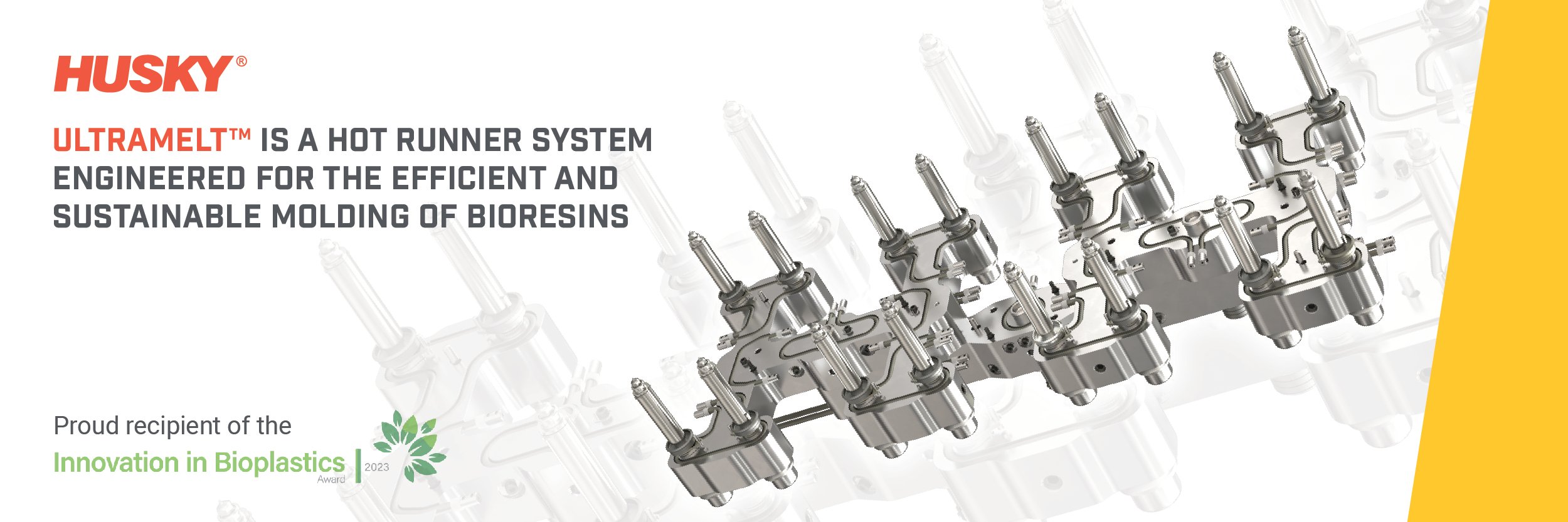
Husky’s UltraMelt™ hot runner technology
These features have made UltraMelt™ a common choice for processing bioresins such as polyhydroxyalkanoates (PHA) and polylactic acid (PLA) in small technical and medical parts.
Reach out to a Husky expert to learn how UltraMelt™ can be configured for your bioresin application, or download our guide, "How to succeed with bioresin for injection-molded applications."